Saturday, 26 October 2002
On Wednesday Jon Udell wrote about Vonage, VoIP service for the home. You get a real, portable phone number in your choice of area code (just move the box to a different network, plug it in, and your phone calls are routed there), all the typical features the phone company wants to charge you extra for such as call waiting, three-way calling, caller ID and voice mail, and wonderful call forwarding services. Currently I have Vonage set to ring the IP phone for 10 seconds, forward to the POTS, and if 30 seconds pass without an answer there, go to voice mail. You can even check your voice mail messages on Vonage's Web site.
My parents make a lot of long-distance and international calls, and Vonage provides unlimited nationwide calling for $40/month, with 6 cents/minute to Australia. I had sent an email to my parents back in August about Vonage, but we'd all been too busy to deal with it. Jon's mention reminded me to take a closer look. I ordered the service Wednesday night, the Cisco box shipped Thursday, it arrived Friday, and my parents just set it up tonight without any help from me. It's really as simple as plugging in the phone, Ethernet and power connections, and you have a dial tone. Voice quality is better than CDMA cellular (which I'm used to, I don't use my land line any more) and the latency is unnoticeable.
I'd hesitate to recommend it unconditionally until we've tried it out for a few months, but so far, it's fabulous.
 8:31 PM
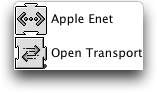 After some tedious manual testing, I finally narrowed the problem down to Open Transport. Open Transport 2.8, installed as part of Jaguar's Classic Compatibility Environment, does not work in a native Mac OS 9 environment. The part that confused me was OT drawing an icon when it loads before Conflict Catcher. I kept on thinking it was the Ethernet driver icon, wondering where the driver was buried, when it turned out not to be so at all. I know they don't look all that similar, but it was late, I was tired…
